
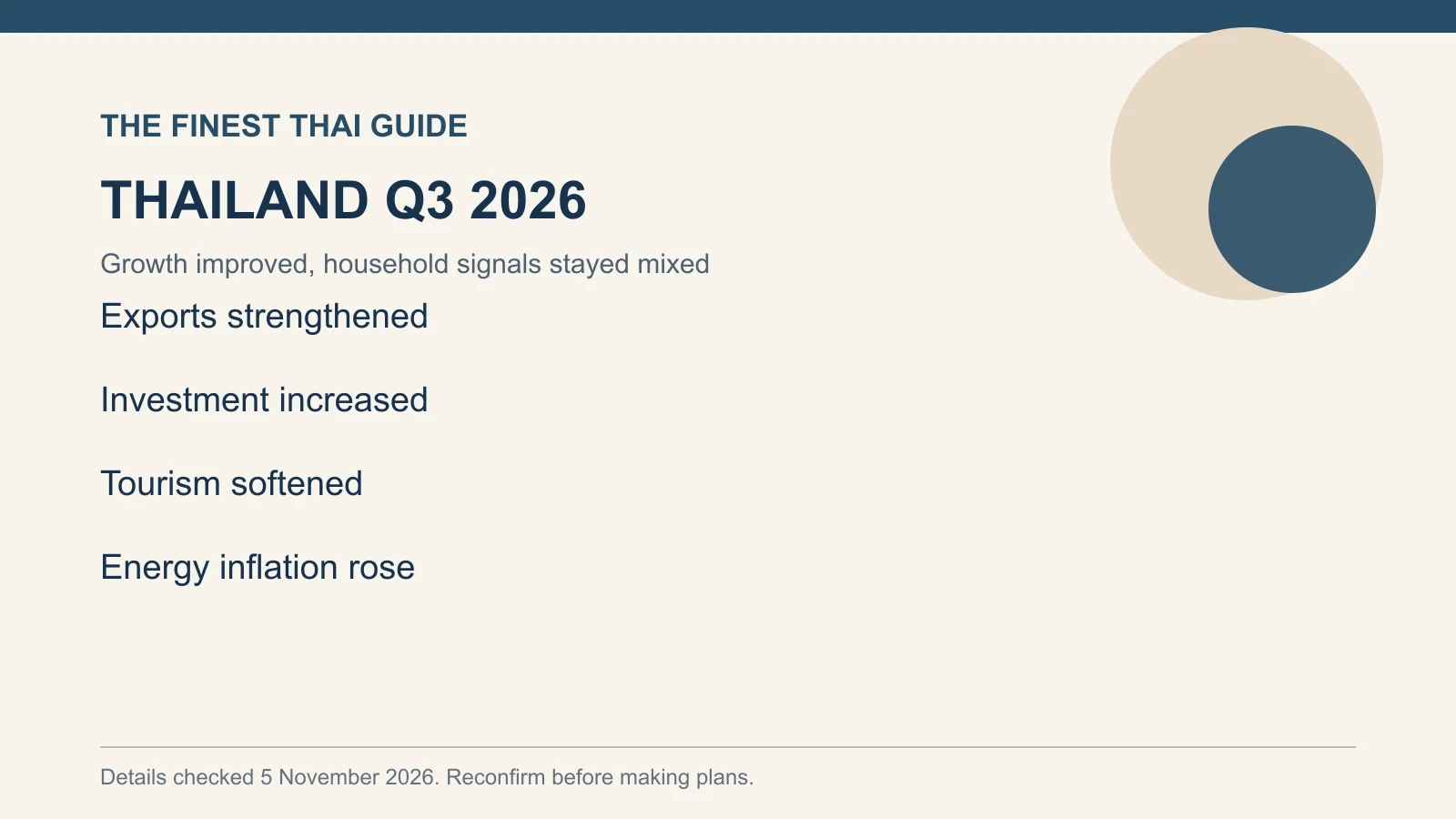
Thailand’s economy improved in the third quarter of 2026 compared with the previous quarter, according to the Bank of Thailand. Merchandise exports excluding gold benefited from the global technology and artificial-intelligence cycle, while private investment increased, especially around machinery, equipment and data centres. Domestic demand also improved.
The household picture was less uniform. Tourism activity softened, September services consumption weakened as living costs weighed on spending, and headline inflation rose with energy prices. Fresh food and core inflation were broadly stable in September, while labour conditions stayed generally stable but unemployment-benefit claimants required monitoring.
Quick Guide
| Q3 direction | Economy improved from the previous quarter |
|---|---|
| Main support | Exports, data-centre investment and domestic demand |
| Tourism | Foreign arrivals softened, especially short-haul markets |
| September inflation | Headline rate rose with energy prices |
| Labour | Broadly stable, with claimant trends to watch |
Separate Growth From Your Budget
A stronger national quarter does not mean every household has more disposable income. Export and data-centre investment can lift activity without immediately lowering rent, food or transport costs. Start with actual bank statements and bills rather than using a macro headline as a personal forecast.
Compare the last three months of essential spending with the prior three on the same basis. Separate one-off travel, medical or school costs from recurring changes. A clear variance table shows whether pressure comes from price, quantity or a new commitment, which is more useful than guessing what GDP will do next.
Watch Energy Exposure
The central bank linked September’s rise in headline inflation to energy prices. Households experience that through fuel, electricity, delivery charges and travel, even when core inflation is steadier. Identify which costs move quickly with oil and which are fixed by contract.
Drivers can track fuel per kilometre rather than only the pump price. Apartment residents should compare the electricity rate on the bill with the tenancy agreement and official utility framework. Businesses and freelancers should keep personal and work transport separate so a changing fuel bill does not distort both budgets.
Read Tourism Signals Carefully
Foreign arrivals weakened, particularly from short-haul markets, while longer average stays supported receipts. This can affect hotels, restaurants, tours, retail and freelance work unevenly. A quieter month for one business is not proof of a permanent national trend.
Anyone paid by tourism should build cash planning from confirmed bookings, realistic cancellation patterns and seasonality. Avoid assuming a large upcoming event will fill every supplier. Keep a minimum-expense month visible and decide in advance which discretionary costs can pause if income arrives later than expected.
Check Employment Resilience
The labour market remained broadly stable, but the rising share of unemployment-benefit claimants deserves attention. Employees should know notice, final-pay, insurance and visa dependencies before a problem occurs. Expats whose permission to stay or insurance is tied to work need a separate administrative plan.
Maintain an updated employment file containing the contract, recent payslips, leave balance and benefit contacts. Do not store sensitive identity documents in an unprotected shared folder. A contingency plan is not a prediction of job loss; it is a way to reduce rushed decisions if an employer changes hours, role or headcount.
Avoid Turning Data Into a Trade
The Bank of Thailand release describes economic conditions; it does not recommend a currency, stock, bond or property transaction. Exchange rates and asset prices respond to many forces beyond one quarterly summary. A current observation can be correct without supporting a profitable personal trade.
Use the report to ask better questions about savings horizon, currency needs and debt service. Keep near-term expenses in a suitable liquid form and seek regulated advice for investments or refinancing. Anyone promising a guaranteed return from an economic release is selling certainty that the data cannot provide.
Make It Work
The Q3 report points to a country with stronger export and investment momentum but persistent differences across tourism, household services, energy costs and employment. That mixed picture is a reason for more precise budgeting, not alarm or celebration.
Review actual household numbers, identify energy-sensitive costs and build a small contingency for income timing. Revisit the next official release when it arrives, but let signed contracts, verified bills and individual goals control personal decisions.
Continue Exploring
Continue with Thailand money guides, compare expat practical guides, and keep Thailand property guides nearby for the rest of the trip.
FAQ
Did Thailand’s economy improve in Q3 2026?
Yes. The Bank of Thailand reported improvement from the previous quarter, supported by exports, private investment and domestic demand.
Why did September headline inflation rise?
The release linked the increase mainly to higher energy prices.
Is this investment advice?
No. The economic release is context for household checks and does not establish a suitable investment, currency or borrowing decision.
Practical Information
The Bank of Thailand published the September and Q3 2026 economic conditions on 30 October 2026. Use the release as national context, then review your own bills, income schedule, debt terms and emergency liquidity. Seek regulated professional advice for personal investment, tax or credit decisions.